BondbloX
- 3.6
- Rating
- 50.00K
- Installs
- Free
- Price

 Analysis by App-foxy
I approached BondbloX as a finance app for a very specific kind of shared decision: when more than one person in a household wants to understand, discuss, or monitor bond opportunities without treating a phone screen like a casual shopping app. Its focus is bond trading, market information, and analytics, so the useful question is not whether it replaces a bank app. The better question is whether it gives a household a clearer starting point for conversations about fixed-income investing.
My overall impression is mixed but positive for the right audience. I like the idea of putting bond-focused information in one place, especially for someone who finds ordinary investment apps too centered on shares and funds. At the same time, this is not an app I would hand to every member of a family and expect instant understanding. Bonds involve maturity, yield, issuer risk, liquidity, and currency considerations, and a compact mobile interface can make those details feel easier than they really are. I would use it as a research and coordination tool, not as a substitute for careful financial judgement.
How BondbloX fits into shared household investing
When I bring BondbloX into a household investing conversation, I’d first agree on the purpose of the session: learning, comparing bond ideas, or reviewing a decision already under consideration. That small distinction helps keep curiosity separate from account access and trading authority. It also gives each person a useful role—one can ask what the figures mean while another checks whether the idea fits the household’s goals.
You May Also Like

 Blood Strike: 2.5 Anniversary
Blood Strike’s Loadouts Turn Every Drop Into a Tactical Gamble
A close look at Blood Strike’s custom loadouts: how fast access to signature weapons reshapes its battle royale rhythm, rewards preparation, and narrows the gap between fights.

 Pandora - Music & Podcasts
Pandora’s Music Is Easy to Start, but Harder to Recover
Pandora’s strength is its low-effort path from a seed to a station. Its weak spot is how much confidence it asks you to place in connection, setup, and quiet recovery.

 8 Ball Pool
 Is Built on Rivalries, Rematches, and Routine
A close look at the rivalries, rematches, shared routines, and unanswered safety questions that turn a quick pool match into a persistent mobile community.

 Samsung Music
’s Quiet Strength Is Playing What You Already Own
Its reach comes less from spectacle than from dependable access to a personal library. That simplicity is both the app’s strongest retention engine and its ceiling.

 AccuWeather: Weather Radar
AccuWeather Review: A Quick, Clear Forecast for Everyday Decisions
For everyday plans, the best forecast is the one you can understand quickly. AccuWeather makes rain timing, radar, and local conditions easy to act on, with a few trade-offs.

 Hill Climb Racing
Why Hill Climb Racing Still Turns Crashes Into One More Run
A tiny car, a bumpy hill and one more upgrade: Hill Climb Racing keeps resurfacing because its simple chaos makes every near-miss feel personal.
More From Our News Desk
View All News


A realistic shared-device scenario
Imagine two adults at home reviewing their finances after dinner. One person is comfortable reading market figures, while the other wants to know why a particular bond might fit a savings plan better than leaving all available money in cash. In that situation, BondbloX can serve as a common screen for the discussion. Instead of passing around separate messages or relying on a vague description of “a bond with a decent return,” both people can look at the same bond-related information and ask more precise questions.
That shared use is valuable because investing decisions often fail at the communication stage. One person may focus on income, while the other worries about access to the money or the possibility of loss. A bond analytics app can help move the conversation from general impressions toward the characteristics that actually matter. I would still write down the key points separately, because a phone session is not a durable household record and the app should not become the only place where a joint decision exists.
The strongest household use case is therefore coordinated research rather than shared control. I would not assume that opening the same app on a family device creates a joint portfolio, a family account, or a reliable division of responsibilities. Those boundaries need to be agreed on by the people involved. If one person is only browsing and another is responsible for execution, they should say that clearly before anyone moves from research to a transaction.
What the app is trying to solve
BondbloX is developed by BondbloX Pte. Ltd. and sits in the finance category. Its store summary points to bond trading, data, and analytics, which tells me that the app is aimed at users who want more than a basic balance screen. The appeal is its specialization. Many mainstream finance apps make shares, exchange-traded funds, or cash management the center of attention, leaving bonds as a secondary product. A bond-focused tool can make fixed-income research feel less buried.
That specialization also creates a trade-off. A person who only wants to check a bank balance, send money, or see a simple investment total may find the subject matter too narrow. I would not recommend installing it merely because someone is beginning to save. It makes more sense when the household has a genuine reason to examine bonds and is prepared to learn the vocabulary around them.
Setting boundaries before anyone uses a shared phone
On a shared device, the first practical step is deciding whose financial activity the app represents. A household may share a tablet or phone, but that does not mean every person should browse under the same identity or handle another person’s account. Before signing in, I would agree on who owns the account, who is allowed to view it, and who is allowed to make decisions based on what appears on screen.
This matters even more with an investment-oriented app than with a news reader. A casual glance at market information is one thing; entering account details or proceeding toward a trade is another. I would keep personal credentials private, avoid leaving an account open for the next person, and make a habit of closing the session when the device changes hands. These are simple habits, but they prevent a shared screen from becoming an accidental permission system.
I also recommend separating education from execution. A teenager or another relative might be welcome to ask questions while an adult explains what a bond is, yet that does not mean the younger person should be given access to financial actions. The app’s Everyone age classification makes it broadly suitable from a content standpoint, but an age label is not the same as investment readiness. Financial responsibility depends on understanding and supervision, not just on whether the app can be installed.
Coordinating research without creating confusion
For a couple or family member working together, I would use a short repeatable process. First, identify the goal: regular income, preservation of capital, diversification, or simply learning. Next, note the questions that must be answered before considering a bond. Finally, compare the information in the app with the household’s time horizon and ability to tolerate loss. This keeps the discussion anchored to a purpose instead of turning the latest interesting listing into an automatic candidate.
One useful habit is to have one person explain the bond in plain language while the other challenges the explanation. If the explanation cannot cover who issued it, when the money is expected to come back, what could reduce its value, and how easily it might be sold, the research is not finished. BondbloX may make data and analytics more accessible, but it cannot remove the need to interpret them. I see that as a strength of disciplined use: the app can organize questions without pretending that investing is effortless.
Another practical tip is to keep a household decision note outside the app. Record the date of the discussion, the intended holding period, the reason for considering the bond, and the conditions that would make the family change its mind. This avoids a common problem with mobile research: people remember the attractive figure and forget the original reason they were looking. The note also helps when one household member was absent from the conversation.
Why bond analytics need slower reading
The word “analytics” can make an app sound self-explanatory, but financial figures only help when the user understands what they represent. A yield figure is not the same as a guaranteed return, and a bond that looks attractive on one measure may be unsuitable because of maturity, issuer quality, currency exposure, or limited liquidity. I would never show a relative a single number and describe it as the answer.
This is where BondbloX is better suited to a deliberate user than to an impulsive one. The app’s role is most useful when it encourages comparison and questions. It becomes less useful when someone treats the presence of detailed market information as proof that a decision is safe. A clean interface can reduce friction, but reducing friction is not the same as reducing risk.
For a household, I would divide the work. One person can inspect the available bond information, while another checks whether the proposed investment fits the family budget and emergency savings. That division is more helpful than having both people stare at the same screen and assume agreement. It also exposes a subtle trade-off: a bond may look appropriate in isolation while still being a poor choice for the household’s overall mix of cash and investments.
Age, trust, and the limits of family sharing
Because the content rating is Everyone, a family may reasonably view BondbloX as accessible in a general sense. I would still introduce it differently to different age groups. For a young person, I would use it as a teaching aid: explain the difference between lending money and owning a company, discuss why repayment dates matter, and show how a financial decision can involve uncertainty. I would not frame the app as a game or encourage a child to treat market figures as points to collect.
Trust also needs a practical definition. A trusted family member may be allowed to sit beside me while I research, but that does not automatically give them permission to use my account. In my view, the safest arrangement is clear verbal agreement plus separate responsibility. If a household cannot agree who is making the decision, who is funding it, and who is monitoring it, the correct next step is to pause rather than open the trade screen.
This makes the app a poor fit for households looking for built-in family management. I would not choose it on the assumption that it provides child profiles, shared approvals, or automatic separation between relatives. The editorial value here is precisely the opposite: families should create their own boundaries instead of expecting a finance app to understand their relationships.
Everyday alternatives and where this app stands
The usual alternative is a bank or brokerage app. Those tools are often better for seeing actual balances, completing transactions, and managing a broader account. If my main need were to confirm whether money arrived or to review my complete portfolio, I would start there. A general investment platform may also be more convenient for someone who wants shares, funds, and bonds together in one familiar dashboard.
BondbloX is more interesting when the household’s question is specifically about bonds and the information surrounding them. Its focused identity can make research feel less distracted than a general-purpose finance app. The cost of that focus is that it may not be the only app needed. I would expect to move between specialized research and the platform that actually holds or executes the investment, taking care not to confuse information viewed in one place with ownership recorded in another.
There is also a difference between a market-data tool and a personal finance planner. A budgeting app may be better for deciding how much the household can afford to invest, while BondbloX is more relevant after that question has been narrowed. Using it before the budget is clear can put the cart before the horse. I would first establish an emergency reserve and a realistic time horizon, then use bond research to investigate whether a particular idea deserves further attention.
Practical details before installing
BondbloX is free to install, although in-app purchases are listed from $21.99 to $59.99 per item. That makes it important to understand what part of the experience is available without payment and what may require a purchase before committing to a household workflow. I would not let a family member buy anything simply because a feature appears useful; agree in advance who is responsible for purchases and whether the added information is genuinely needed.
The app was released on October 25, 2017, and the current version is 6.70. It requires Android 8.0 or later, so an older shared phone may not be suitable even if it still handles ordinary banking tasks. That compatibility check is worth doing before planning a family session. A device that cannot run the app reliably is a poor foundation for time-sensitive research.
Its average rating is 3.6 from around 205 ratings, with 8 written reviews. I read that as a reason to keep expectations measured rather than as a final verdict. The app has passed the point of being unknown, with over 50 thousand installs, but the audience is still specialized enough that personal fit matters more than popularity. I would test the basic workflow first and only then decide whether it deserves a regular place in the household’s financial routine.
Where I found friction
My main concern is not that BondbloX focuses on bonds; that is its reason to exist. The friction comes from the gap between seeing structured information and knowing what to do with it. A new investor can easily mistake a more detailed screen for a complete analysis. The app is therefore less forgiving than a simple savings tool, especially when two people with different levels of experience are sharing the same display.
Another limitation is the risk of divided attention. If one person is watching figures while another is discussing household goals, the conversation can become fragmented. I would avoid making decisions in a rushed setting, particularly when someone is joining remotely or when the device is being passed between several relatives. A short written summary after the session is more reliable than assuming everyone remembers the same details.
I would also skip it if the household wants a single, uncomplicated place for budgeting, banking, retirement planning, and investment execution. A specialized bond app can be useful without being a complete financial home. Choosing it for a job it was not designed to do would create unnecessary switching and potentially more confusion.
Who should use it and who should look elsewhere
I think BondbloX is worth considering for an adult investor who already understands the basics of bonds and wants a more focused way to examine bond-related trading information and analytics. It can also suit a couple who wants to research together, provided they treat the app as a discussion aid and maintain clear account boundaries. The strongest users will be patient readers who are comfortable checking details instead of chasing the most appealing figure.
I would point beginners toward a slower learning process before encouraging them to rely on it. That could mean studying bond terminology, discussing risk with a qualified adviser, and using a general budgeting tool to establish what money is genuinely available. The app may support that learning, but it should not be the only teacher. I would also steer away users who dislike specialized interfaces or who need a straightforward household dashboard.
For shared-device use, the deciding factor is maturity rather than the Everyone label. An adult can demonstrate the app to a younger family member without handing over credentials or decision-making power. A couple can research side by side without merging their financial identities. In both cases, the app works best when the boundaries are agreed before the screen is opened.
My household verdict
After considering its purpose, I see BondbloX as a focused finance companion rather than an all-purpose investment solution. I like that it gives bond discussions a dedicated place and may help households ask better questions than they would after glancing at a generic portfolio total. The free entry point makes it reasonable to explore, while the listed in-app purchase range means I would review any paid feature carefully before making it part of a shared routine.
My recommendation is conditional but clear: use it when bonds are the subject, keep account ownership separate, and make every decision answer to a household goal. Do not treat an Everyone rating as permission for unsupervised investing, and do not confuse analytics with certainty. If you need everyday banking, broad portfolio management, or family budgeting, a bank, brokerage, or budgeting app may be the better primary tool.
For the right reader, though, BondbloX can add useful structure to a part of finance that is often overlooked. I would install it on a compatible device, explore its bond-focused workflow before paying for anything, and use it during calm, documented conversations rather than rushed decisions. Its real value is helping people coordinate their questions; the responsibility for the answers still belongs to the household.
FAQs for BondbloX
01What is BondbloX and how does it work?
BondbloX is a digital bond investment platform designed to make fixed-income investing more accessible through fractional ownership. Instead of purchasing an entire bond, eligible users may be able to buy smaller portions, known as BondbloX, depending on the product and market. The app provides information about available bonds, pricing, maturity, expected returns, and related terms, helping investors review opportunities before placing an order.
02Who can use BondbloX and what are the account requirements?
BondbloX is generally intended for verified investors who meet the platform’s eligibility, residency, and regulatory requirements. During registration, users may need to provide identity documents, tax information, banking details, and other information required for know-your-customer checks. Availability can differ by country and investor category, so downloading the app does not necessarily mean every feature or bond will be accessible to everyone.
03Is investing through BondbloX safe and guaranteed?
BondbloX may provide access to regulated bond products, but investing through the app is not risk-free. Bond prices can change, issuers can experience financial difficulties, and returns may differ from expectations if a bond is sold before maturity. Any protection, custody arrangement, or regulatory coverage depends on the specific jurisdiction and product. Users should read the offering documents and understand the risks before investing.
04What fees and minimum investment amounts should I expect?
The minimum investment and applicable charges depend on the bond, currency, market, and account type. Potential costs may include transaction fees, custody or platform charges, currency-conversion costs, taxes, and fees related to transferring or selling an investment. Before confirming an order, review the fee schedule and transaction summary carefully. A low entry amount does not automatically mean the investment has low overall costs.
05Can I sell or withdraw my BondbloX investment whenever I want?
The ability to sell BondbloX holdings or withdraw money depends on market liquidity, trading availability, settlement times, and the terms of the specific bond. Some products may be easier to sell than others, and selling before maturity can result in a gain or loss if market prices have changed. Users should also check withdrawal limits, bank-processing times, and any applicable charges before committing funds.
Pros
- Clear bond-market focus for users seeking fixed-income opportunities.
- Accessible interface makes bond information easier to understand.
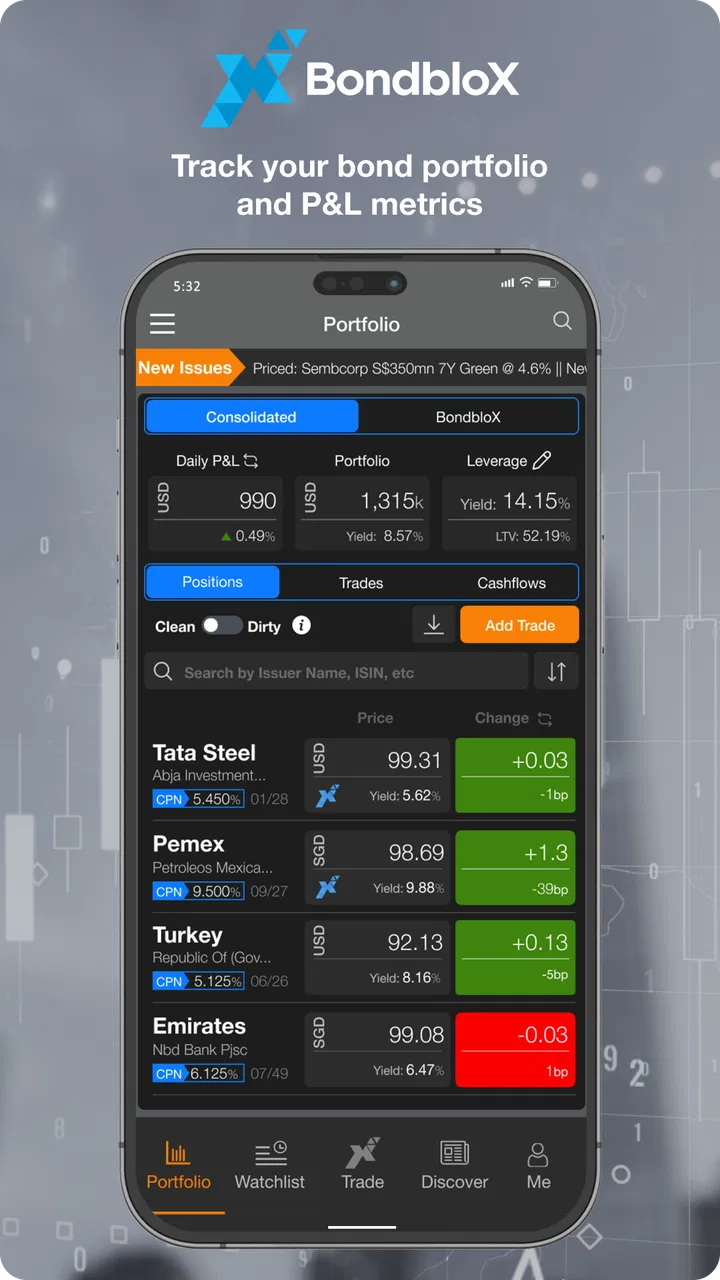
- Useful portfolio view for monitoring investments in one place.
- Can help diversify beyond traditional stocks and savings products.
- Digital access simplifies discovering and comparing available bonds.
Cons
- Bond availability may vary by country
- account type
- and eligibility.
- Fixed-income investments still carry issuer and market-related risks.
- Some features may require verification or additional account documentation.
- Returns can be less attractive when interest rates or fees change.
- The platform may feel limited for users seeking stocks or crypto assets.

BondbloX
Gallery